
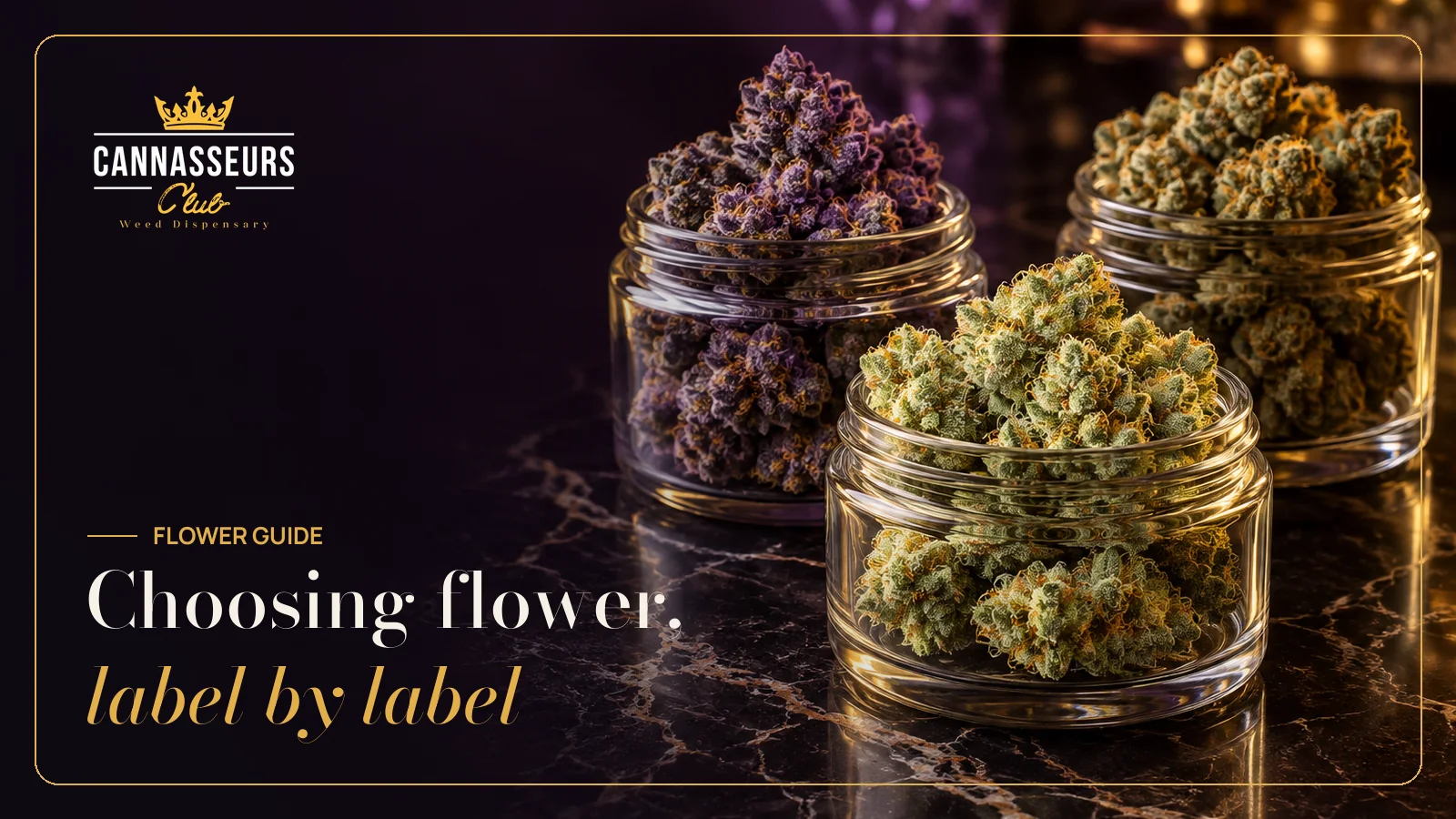
Choose cannabis flower by smell, freshness and lab data first, and use the indica, sativa or hybrid label as a loose hint rather than a promise. Those labels describe a plant's family tree, not a fixed experience, so the terpenes on the COA and the way the bud looks and smells tell you more.
What indica, sativa and hybrid actually mean
The three labels started as botany. Indica described short, bushy plants with broad leaves, traced to the mountains of Afghanistan and Pakistan. Sativa described taller plants with narrow leaves from warmer regions closer to the equator. After decades of crossbreeding, nearly everything on a California shelf is a hybrid of some kind, and the label on the jar mostly tells you which side of the family tree a breeder or grower thinks the strain leans toward.
That history is why the labels are an imperfect guide to effects, and why learning how to choose cannabis flower starts with looking past them. Two strains both sold as indica can smell nothing alike and feel different too, because what you experience depends more on the mix of cannabinoids and terpenes in that particular batch, how much you use and your own body chemistry. Use the label to start a conversation, not to end one.
| Label | What it tells you | What people commonly report | House strains to ask about (check the menu label) |
|---|---|---|---|
| Indica | Lineage leans toward the short, broad-leaf side of the family | Many describe indica-labeled flower as more relaxing and body-focused, and save it for evenings | God's Gift (Granddaddy Purple x OG Kush), Godfather OG |
| Sativa | Lineage leans toward the tall, narrow-leaf side | Often described as brighter and more head-focused, and picked for daytime | Rotation changes, so ask what is live this week |
| Hybrid | A deliberate cross of both sides, which covers most modern strains | Anywhere in between, depending on the specific cross and batch | OG Kush, Girl Scout Cookies, Birthday Cake, Acai Gelato |
Everyone responds differently, so read that middle column as a rough pattern, not a prediction for you.
Terpenes: what your nose is telling you
Terpenes are the aromatic compounds that give cannabis its smell, the same family of compounds you find in citrus peel, pine needles and lavender. A lot of experienced shoppers now pick flower by terpene profile rather than by label. If a package lists terpenes, they had to be tested by the lab. Research on how terpenes shape the experience is still young, so take the notes below as what people commonly report, not as promises.
- Myrcene: earthy and musky, a little like ripe mango or hops. It turns up often in indica-labeled strains, and people frequently describe myrcene-heavy flower as mellow and heavy in the body.
- Limonene: bright citrus peel. Limonene-forward strains are often described as upbeat and cheerful.
- Caryophyllene: peppery and spicy, like cracked black pepper or cloves. People tend to describe it as warm and grounded.
- Pinene: fresh pine and rosemary. Shoppers often say pinene-forward flower feels clear and alert.
- Linalool: floral, close to lavender. Commonly described as calm and soft around the edges.
A practical habit: when a strain smells great to you, note its top two or three terpenes from the label or the certificate of analysis (COA). After a few purchases you will usually spot a pattern in what you enjoy, and that pattern is more reliable than any indica or sativa sticker.
Why THC percentage is not the whole story
A big THC number is easy to shop by, but it is a blunt tool. California requires the labeled THC to land within plus or minus 10 percent of the lab result, and potency shifts from one harvest to the next. Two jars at the same percentage can feel very different because of terpenes, freshness and the minor cannabinoids that never make it onto the front of the label. A fresh, loud-smelling jar in the low 20s can be a more enjoyable smoke than a flat-smelling one with a bigger number.
If you are newer or your tolerance is low, a higher percentage mostly means it is easier to take more than you meant to. Start with a small amount and give it a few minutes. Our guide to how cannabis is lab tested in California explains what the numbers on a COA mean.
How to judge flower when you can see it
When a budtender shows you the flower, these are the things worth checking.
- Look: buds should have a natural structure and color, anywhere from lime green to deep purple depending on genetics, with orange or rust-colored pistils (the little hairs) threaded through. Pass on anything that looks crushed, matted or damp.
- Trichomes: the tiny crystal-like glands that hold most of the cannabinoids and terpenes. You want them intact and visible, giving the bud a frosty coat. Rough handling knocks them off, so bud that looks dull and smooth has often been bounced around.
- Smell: a strong, distinct aroma that matches the strain's reputation is a good sign. Flower that smells like hay or cut grass usually was not dried and cured carefully.
- Curing and moisture: well-cured flower is a little springy, and small stems snap rather than bend. Bone-dry bud that crumbles to dust burns fast and harsh; bud that feels spongy was packed too wet.
- Trim: hand-trimmed buds keep their natural shape and more of their trichomes, while machine-trimmed buds can look tight and shaved. Trim quality is a quick read on how much care went into the batch.
- Packaging date: find the packaged or harvest date on the label. Fresher flower generally smells and smokes better, and a jar that has sat for months has usually lost some of its aroma.
Sizes and value: from an eighth to an ounce
Flower is sold by weight. The common sizes are an eighth (3.5 grams), a quarter (7 grams), a half (14 grams) and an ounce (28 grams). Larger sizes usually cost less per gram, but only buy what you will finish while it is still fresh. If you are trying a new strain, an eighth is the low-risk way in. California lets adult-use customers buy up to 28.5 grams of flower a day, so an ounce sits just under that limit.
Smalls are worth knowing about. They are smaller buds, usually from lower on the same plants that grow the big top colas, and they are often priced lower per gram. Same genetics, just less photogenic. If you grind everything for joints anyway, smalls are an easy way to stretch a budget. You can compare sizes and strains across our full flower selection.
Where Cannasseurs house flower fits
Cannasseurs grows its own house flower in a licensed indoor hydroponic facility in Southern California, where it is dried and cured before we sell it at the North Hollywood counter with no distributor in between. It is usually the largest single brand on our shelf. Every batch is tested by a state-licensed lab for potency, pesticides, microbials and heavy metals, and only passing batches get jarred with a batch number. Here is how the house garden works, from clone room to jar.
Genetics in regular rotation include OG Kush (earthy, pine and citrus, typically testing in the high 20s), God's Gift (Granddaddy Purple x OG Kush, with grape and hash aromas, grown since our early days), Girl Scout Cookies (sweet, earthy and minty), Birthday Cake, Acai Gelato, Godfather OG and California Back Roze. House flower comes in eighths, 14-gram halves and ounces. House eighths start around $15, though prices move with each harvest and the live menu is the final word. The current lineup is on our house flower page.
Questions to ask your budtender
- When was this batch packaged, and is there anything fresher?
- Can I see the COA, and what are the top terpenes?
- I liked the last strain I bought. What else on the shelf has a similar smell or terpene mix?
- Should I start with an eighth, or does a half make sense for how often I smoke?
- Are there smalls of this strain, or of something close to it?
- Is this one better in a joint, a pipe or a dry-herb vaporizer?
Good budtenders like these questions, and they can pull up lab results on the spot. If you are weighing loose flower against ready-made joints, our pre-rolls vs flower comparison covers the trade-offs.
Frequently asked questions
Is indica or sativa stronger?
Neither label tells you strength. Potency comes from the specific batch, so check the THC figure and the COA, and remember that terpenes and your own tolerance shape how strong it feels.
How many joints can I roll from an eighth?
It depends on how big you roll them. An eighth is 3.5 grams, so you get roughly three full-gram joints or about seven half-gram ones.
How should I store flower at home?
Keep it in an airtight glass jar in a cool, dark place, away from heat and sunlight, and well out of reach of kids and pets. Plastic bags let flower dry out and crush the trichomes.
What is a certificate of analysis (COA)?
It is the lab report tied to the batch number on the package, showing potency and the state safety screens the batch passed. Budtenders can pull it up for any product on the shelf.
What do I need to bring to buy flower?
Adults 21 and over need a valid government photo ID. Medical patients 18 and over also need a valid physician's recommendation. Our first-time visit page walks through the rest.
Visit Cannasseurs Club
Address11307 Vanowen St, North Hollywood, CA 91605
On Vanowen St, just east of Tujunga Ave
HoursOpen daily, 10 AM to 10 PM
Call(818) 358-2770
Plan your tripGet directions · Live menu
Sources: California Department of Cannabis Control: consumer information · California Department of Cannabis Control
Keep reading
 Pre-Rolls vs Flower: Which Format Fits the Way You Shop?
 How Cannabis Is Tested in California (and How to Read a COA)
 Inside a Vertically Integrated Cannabis Operation
For adults 21 and over, or 18 and over with a valid physician's recommendation. This guide is general information, not medical or legal advice. Cannasseurs Club, California license C12-0000361-LIC.