
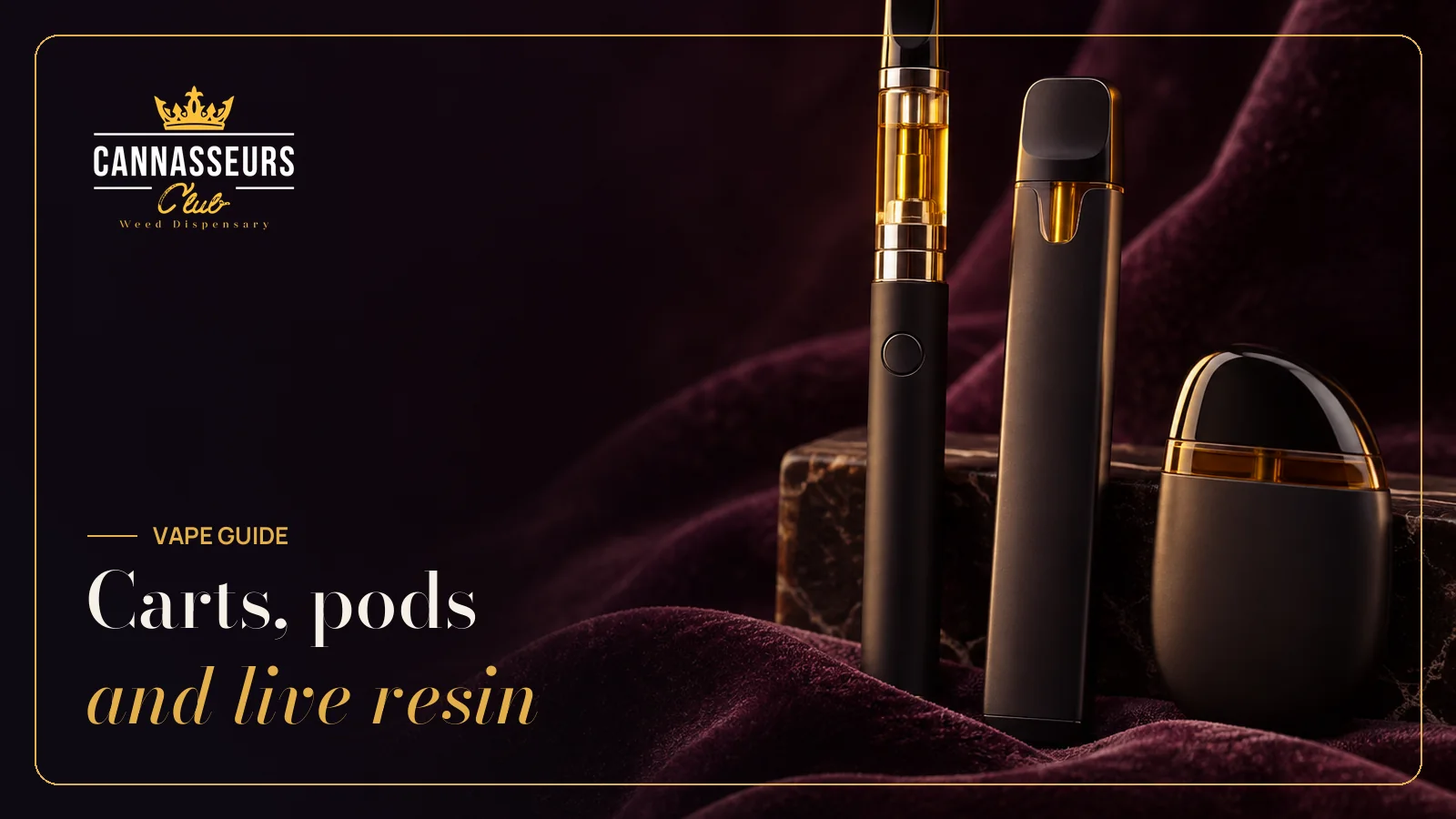
A cannabis vape comes down to two choices: the hardware (a 510-thread cartridge on a battery, a proprietary pod, or an all-in-one disposable) and the oil inside it (distillate, live resin, live rosin or a full-spectrum extract). Pick the hardware for convenience and the oil for flavor, then buy from a licensed shop so every cart has a batch number and a lab result behind it.
The three kinds of vape hardware
Every vape is a heating coil, a battery and a small reservoir of oil. How those pieces fit together decides how much setup you do and how much choice you get. Our vape wall in North Hollywood usually holds more than 200 carts, pods and disposables, so it helps to know which family you want before you start reading labels.
510-thread cartridges
A 510 cart is a small glass or ceramic tank of oil with a standard screw thread on the bottom. It screws onto a 510 battery, anything from a slim pen to a pocket-size box with buttons and voltage settings. Carts commonly come in half-gram and full-gram sizes. Because the thread is universal, one battery lets you swap between brands, strains and oil types.
Proprietary pods
Pod systems lock a brand's pods into that brand's own battery. STIIIZY pods are the familiar example: the pod clicks into place and there is nothing to screw on or adjust. The trade-off is that the battery only works with that brand's pods.
All-in-one disposables
An all-in-one puts the oil, the coil and the battery in a single sealed device. You open the box and use it. Many have a charging port so the battery keeps up with the oil, and when the oil runs out, the whole device is done. Please don't toss spent vapes in the household trash; lithium batteries belong at a battery or e-waste drop-off.
| Hardware type | Pros | Things to know |
|---|---|---|
| 510-thread cartridge with a battery | Widest choice of brands and oils; one battery runs many carts; some batteries let you set the voltage | The battery is a separate purchase; thick oils run better on a battery with a preheat setting |
| Proprietary pod (such as STIIIZY) | Click-in simplicity; battery and pod are designed to work together | Pods only fit that brand's battery, so you're tied to one lineup |
| All-in-one disposable | No setup, nothing to match, easy to carry | Usually no voltage control; the device is finished when the oil is, so it creates more waste per gram |
What's inside: distillate, live resin, live rosin and full-spectrum oil
The hardware heats the oil; the oil decides the flavor and how close each pull tastes to the plant. Here's how the main types are made.
Distillate with added terpenes
Distillate is cannabis oil refined until it is mostly THC with almost no flavor of its own. Because refining strips out the plant's natural aroma, producers add terpenes back in, and those terpenes come from one of two places. Cannabis-derived terpenes are captured from cannabis plants, so the flavor tends to follow a real strain. Botanical terpenes come from other plants, such as citrus, herbs or pine, and are blended to mimic a strain or to build a flavor like mango or berry. Distillate carts are consistent from one to the next, which is a big part of their appeal. If the box doesn't say which kind went in, ask.
Live resin
Live resin starts with plants that are frozen right after harvest instead of being dried and cured. The frozen material is extracted with a hydrocarbon solvent, the solvent is purged, and the finished oil is tested for residual solvents like every licensed extract. Freezing holds on to more of the fresh plant's aroma, so live resin carts tend to taste brighter and more like the living plant than distillate does.
Live rosin
Live rosin skips solvents entirely. Fresh-frozen plants are washed in ice water to knock loose the resin glands, that hash is dried, and then it's pressed with heat and pressure. Many people describe the flavor as the closest thing to smelling the flower itself. Rosin is thicker than distillate, so it often runs better with a preheat cycle, and it can darken over time, which is normal.
Full-spectrum and CO2 oil
Full-spectrum oils try to keep a broad range of the plant's cannabinoids and terpenes together rather than isolating THC. Some are made with CO2 extraction, which uses pressurized carbon dioxide instead of a hydrocarbon solvent. The flavor usually sits between distillate and live resin: earthier, with less of a candy profile.
Battery basics: keep the heat low
Most harsh, burnt-tasting hits come from too much heat, not bad oil. If your battery has settings, start on the lowest one. Lower voltage warms the oil gently and keeps the terpenes intact; higher voltage makes a bigger cloud but can scorch the oil and the coil, and a scorched coil never tastes right again.
- Take short, slow draws. Two or three seconds is plenty. Long, hard pulls overheat the coil.
- Use preheat for thick oil. A quick preheat cycle loosens rosin or a cart that has been sitting somewhere cool.
- Give it a rest between pulls. Chain-pulling dries the wick faster than oil can soak back in, and that's where the burnt taste comes from.
Inhaled cannabis comes on within minutes, so pace yourself: one or two small puffs, then wait 10 to 15 minutes before deciding on more. Never vape and drive. Driving while impaired is a DUI in California.
Budtender tip: If a brand-new cart tastes burnt on the first pull, it may have been stored on its side. Stand it upright for a few minutes so the oil settles around the coil, then retry on the lowest setting.
Storage and clogging: upright, capped and out of the heat
Cannabis oil thickens in the cold and thins out in the heat. Too cold and it won't reach the coil; too hot and it can leak or lose flavor. A car parked in the Valley in August gets far hotter than any cart likes, so don't leave vapes in the glovebox or cup holder. Store them upright at room temperature, out of direct sun, with the mouthpiece cap on.
If a cart clogs, work through these in order:
- Warm it in your hand for a minute, or run one preheat cycle.
- Take a few gentle draws without pressing the button to pull the oil loose.
- If the mouthpiece is blocked, clear it with a twist of paper towel, never anything sharp.
At home, keep vapes in child-resistant packaging, away from kids and pets. On the road, keep them sealed or in the trunk.
How to spot a legal, tested cart
Empty packaging for popular brands is easy to buy online, so a familiar box proves nothing. What matters is where the cart came from and whether it traces back to a lab result. Look for:
- The California universal cannabis symbol on the package, along with child-resistant packaging.
- A batch number. It ties the cart to its certificate of analysis (COA).
- A COA from a state-licensed lab. In California every batch is tested for potency, residual solvents, pesticides, heavy metals and microbial contaminants before it can be sold, and the THC on the label has to land within 10 percent of the lab result. Our budtenders can pull up the COA for the cart in your hand.
- A licensed retailer. Every legal shop has a state license number you can look up with the Department of Cannabis Control. Ours is C12-0000361-LIC.
This isn't box-ticking. In 2019, an outbreak of serious lung injuries linked to vaping, known as EVALI, was tied mainly to vitamin E acetate in illicit THC cartridges, according to the CDC. Licensed, tested products are the safer route. For a closer look at what the lab checks, read our guide to how cannabis is tested in California.
Vape brands we often carry
Stock moves daily, but brands we often carry include STIIIZY, Rove, Raw Garden, Coldfire, PlugPlay, Big Chief, Ganjeez, Flavorade, Turn and Dee Thai, alongside our own Cannasseurs cartridges. Those house carts are filled from the same indoor garden that grows our house flower. The live menu is tied to the register, so it shows current stock, prices and THC figures before you make the trip.
Stuck between two carts? Tell the budtender which flavors you like and which battery you own; that narrows a long wall of carts fast. Curious about the same extracts in a jar? Our concentrates guide covers rosin, resin and the rest.
Frequently asked questions
Will any 510 cart work on any 510 battery?
The thread is a shared standard, so almost any 510 cart screws onto almost any 510 battery. The exceptions are fit and power: some wide carts don't sit flush in a battery's sleeve, and thick rosin carts run more smoothly on a battery with a preheat setting.
Do disposable vapes need charging?
Many do. A lot of all-in-ones have a small charging port so the battery lasts as long as the oil, so check the box for the port type and keep a matching cable handy.
Can I vape in my car or at the park?
No. California doesn't allow cannabis use in public places or in a vehicle, whether you're driving or riding as a passenger. Keep vapes sealed or in the trunk while you travel, and see our California cannabis laws guide for the full rules.
Can I fly with a cannabis vape?
Leave it at home. Cannabis can't legally cross state lines, and federal law applies at airport security.
Does a higher THC number mean a stronger-tasting or better cart?
Not necessarily. Two carts with similar THC can taste and feel quite different because of the terpenes and the oil type, so start with a flavor profile you like and a low battery setting.
Visit Cannasseurs Club
Address11307 Vanowen St, North Hollywood, CA 91605
On Vanowen St, just east of Tujunga Ave
HoursOpen daily, 10 AM to 10 PM
Call(818) 358-2770
Plan your tripGet directions · Live menu
Sources: CDC: Outbreak of lung injury associated with vaping (EVALI) · California Department of Cannabis Control: consumer information · DCC license search
Keep reading
 Cannabis Concentrates Guide: Rosin, Resin, Wax and More
 How Cannabis Is Tested in California (and How to Read a COA)
 North Hollywood Cannabis Buyer's Guide: Flower, Vapes, Edibles and More
For adults 21 and over, or 18 and over with a valid physician's recommendation. This guide is general information, not medical or legal advice. Cannasseurs Club, California license C12-0000361-LIC.